






Battery Management and Electric Vehicles: Oscilloscope Measurements for BMS Testing

Battery Management and Electric Vehicles: Oscilloscope Measurements for BMS Testing
As EVs push farther toward mass adoption, the Battery Management System (BMS) has become the critical watchdog ensuring safety, reliability, and longevity of high?voltage Battery Packs. A modern BMS is a complex mix of analog sensing, digital control, and high?speed communication that must coordinate cell balancing, over/under?voltage protection, temperature monitoring, state-of-charge estimation, and protection against short circuits. For engineers and technicians, oscilloscope measurements are an essential part of the toolbox. They provide a time?domain view of how the BMS responds to events, how gate drives and protection circuits behave, and how signals propagate through a pack during charging, discharging, or fault conditions. This blog post explores how to use an oscilloscope effectively for BMS testing in EVs, with practical guidance, typical waveforms, and setup tips that help you interpret data with confidence.
Understanding the BMS in electric vehicles
The BMS is more than just a voltage monitor. In an EV, a typical battery pack contains dozens to hundreds of cells arranged in series and parallel strings. The BMS keeps track of:
- Cell voltages with high precision to detect imbalance and prevent over?charge or over?discharge.
- Pack current and, often, individual string currents through a shunt or hall sensor.
- Cell temperatures to prevent thermal runaway and manage thermal design.
- State of charge (SOC) and state of health (SOH) estimates derived from voltage, current, and temperature history.
- Balancing strategy (passive bleed or active balancing) and timings.
- Protection logic: under/over?voltage, overcurrent, short circuits, and communication faults.
- Communication with the vehicle controller and other subsystems (CAN, LIN, or other protocols).
Because the BMS touches mechanical, electrical, and software domains, testing it requires a careful mix of electrical measurements, signal integrity analysis, and timing checks. Oscilloscopes excel at revealing transient events—like a sudden current surge, a rapid relay/ MOSFET gate transition, or a CAN bus arbritration moment—that are often missed by static measurements or slow data loggers. By combining time?domain insight with protocol decoding where supported, you gain a comprehensive view of how the BMS behaves under normal operation and during fault conditions.
Oscilloscope essentials for BMS testing
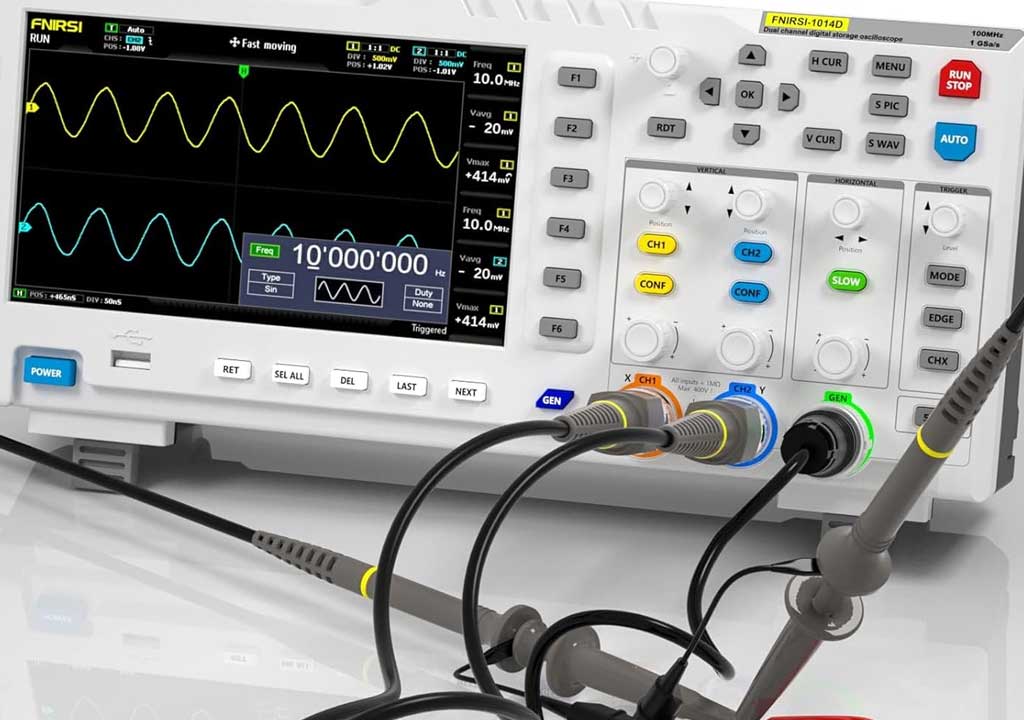
Getting reliable results starts with choosing the right tool and the right probes. Here is a quick guide to the essentials you’ll rely on when probing a BMS in an EV context.
Bandwidth and sample rate matter: EV BMS signals can have fast edges on gate drives or CAN transients in the microsecond to nanosecond range. A general rule of thumb is to use an oscilloscope with at least 100–200 MHz bandwidth for basic gate drive and shunt measurements, and higher bandwidth (500 MHz or more) if you need to capture fast switching transients or CAN transceiver edges with high fidelity. A sampling rate of at least 1–2 GSa/s per channel is a good baseline for a single channel; higher rates help with multi?channel synchronization and jitter analysis.
Probe selection is a major determinant of accuracy and safety:
- Passive 10× probes are standard for most voltage measurements; they offer high impedance and good noise rejection with modest loading.
- Active or differential probes are essential for measuring differential signals (such as a shunt resistor across a high?side sense path) and for reducing common?mode challenges near HV packs.
- Current probes (AC or DC) allow noncontact or minimal?contact measurement of pack current; many BMS tests use a differential sense across a shunt, but a current probe can be invaluable for quick checks.
- Differential probes or pairwise channels with math (V1?V2) help when measuring across sense lines that do not share a clean ground reference.
Grounding and safety cannot be overemphasized in high?voltage environments. Use isolated scopes or differential probes where possible, keep probe grounds short, and never clamp a ground lead onto a live HV node in a way that could create a short circuit.
Measurement planning matters too. Before connecting anything to a pack, you should have a clear plan for what you want to observe, a defined trigger to capture the event, and an expected acceptable range for the waveform. For BMS testing, you will often set up trigger conditions for specific events like a sequencing step of balancers, a fault latch, or the initiation of a current limit.
Key signals to measure on a BMS test bench
When you’re testing a BMS, you typically measure a mix of analog signals and digital communications. Here are the core signal categories to focus on, with guidance on what to look for in the waveforms.
- Cell voltage sense lines: A BMS monitors the voltage of each cell or group of cells. You want to see clean, monotonic voltage changes during charge/discharge, with occasional small step adjustments during balancing. Look for abnormal spikes, noisy measurements, or mis?timed reporting relative to other signals.
- Pack current and shunt path: The current sense path is central to protection logic. You should observe clean edges of current pulses, consistent shunt voltage proportional to current, and any transients when the protection system trips. Differential measurement across the shunt is common.
- Temperature sensor signals: Temperature channels should respond smoothly to thermal events. Watch for sudden jumps or sensor faults that could cause false protections or incorrect SOC estimation.
- Balancing signals: Passive balancing (bleed resistors) or active balancing (DC/DC routing) produces distinctive currents that can be pulsed or stepped. The onset and duration of balancing may be timed to reduce imbalance; the oscilloscope helps verify timing budgets and ensure no contention with other pack activities.
- Gate/drain-source voltages on balancing FETs and high?voltage switching elements: These signals reveal switching behavior and possible cross?talk or shoot?through conditions that could indicate a fault or design issue.
- Power electronics and charger interaction (if accessible): Signals such as charger enable, precharge circuits, and DC link behavior can be observed to verify correct sequencing and protection.
- Vehicle communication (CAN/LIN): Digital bus activity can be captured with high time resolution. Protocol analyzers may exist as built?in scope features; otherwise you’ll decode frames manually by thresholding and timing.
Each category has typical waveform shapes. For example, cell voltages typically show slow changes with small transients during balancing; current traces near the shunt show sharp edges during faults; CAN bus lines show patterned digital frames with characteristic recessive/dominant levels. Interpreting these waveforms requires context: the BMS firmware state, the current operation mode (charging, discharging), and the hardware topology (series/parallel cell connections, shunt location, and balancing topology).
Setting up your measurement system for BMS testing
Creating a safe and reliable test setup involves both hardware and procedure. Here are practical steps to configure your measurement environment for BMS testing in EVs.
1) Define the test objectives. Decide which signals you must observe for the scenario (normal operation, fault injection, balancing events, etc.). This will guide probe placement, bandwidth requirements, and trigger strategies.
2) Prepare the test harness. A well?designed harness minimizes noise pickup and keeps leads short where possible. Use twisted pair wiring for differential measurements, shielded cables for high?frequency signals, and consider a dedicated reference ground for the BMS under test. Ensure that the pack is isolated from your bench ground if the BMS is HV referenced.
3) Choose the right probes and accessories. For a pack with high cell voltages (hundreds of volts), use differential probes for cell sense lines and high?voltage capable probes with proper attenuation. For current measurements, a proper current clamp or shunt amplifier may be necessary to preserve the accuracy and safety of the measurement path.
4) Establish safe operating modes. If you are working with a live pack, ensure proper PPE, enclosure barriers, and interlocks. For lab testing, consider a benchtop pack with a resistor load bank or a programmable DC source to emulate charging and discharging while avoiding dangerous HV exposure when you test or rework the harness.
5) Set up trigger and data capture. A stable trigger helps you consistently capture the event you care about. For BMS tests, you might trigger on a threshold in the shunt voltage, a specific CAN bus frame, or a balancing activation edge. Use a multi?channel peak detect or equivalent when you anticipate fast transient edges.
6) Synchronize channels. If you are comparing multiple signals (for instance, shunt current and cell voltage at the same instant, or gate drive versus the current sense path), synchronize the channels carefully. Use time?base settings that reveal both the fast transitions and the slower cell voltage drift in a single view.
7) Document and annotate. Record a short description of the test, the expected behavior, and the configuration. Waveform annotations and cursors help you compare measurements across test runs and share findings with teammates.
Practical examples: what to look for in real measurements
To illustrate how oscilloscope measurements inform BMS testing, here are a few practical scenarios. Each example includes the signal to observe, the expected behavior, and common pitfalls that can mislead interpretation.
Example 1: Cell balancing activation and current paths
Scenario: A 16S pack with passive balancing (bleed resistors) engages balancing as the SOC drifts between cells. You want to verify that balancing starts at the right voltage threshold, that it is synchronized with other systems, and that it does not draw excess current or cause instability in the voltage sense bus.
What to measure: - A line corresponding to the balancing FETs or resistive bleed network current (often through a sense resistor and a separate path in the BMS). - The voltage across the sense path or the BMS control signal that enables balancing (gate drive if using transistors). - A few cell voltages to verify that the imbalance is decreasing over time while balancing is active.
Expected waveform characteristics: - When balancing starts, you’ll usually see a sudden increase in the balancing current (for a passive bleed, a modest, constant or gently decaying current). - The gate drive signal for the balancing transistor should show a clean transition with minimal delay after the BMS command. - The affected cell voltage steps down as the bleed current reduces the cell’s state of charge relative to its neighbors; you may observe a small, stepwise voltage decrease on the targeted cells.
Common pitfalls: - Noise coupling from the shunt path into voltage sense lines can masquerade as false imbalances; differential measurement helps. - Incorrect ground reference leading to measurement error on the sense path. Always verify your reference point and consider a Kelvin?sense approach if available.
Example 2: Overcurrent protection during fast charging
Scenario: The BMS should limit current during fast charging if a fault condition or protection threshold is reached. You want to verify the timing from fault detection to protection action and ensure that the missing gating or disabling path prevents a hazardous condition.
What to measure: - Pack current (shunt or hall sensor) with high?bandwidth differential measurement. - The BMS control signal that initiates current limiting or disconnection. - The CAN bus frame or other control communication that documents the fault or protection event.
Expected waveform characteristics: - A fast rising edge in current when switching from normal to current?limit mode, followed by a plateau or slow decay as the protection engages.
- The protective action (relay or FET gate) should occur with minimal delay after the sensed threshold is crossed, and you should see a corresponding change in the BMS output signals, such as a reduced charging current command to the charger or to the power electronics interface.Common pitfalls: - Charging source impedance or measurement bandwidth limits can smear the true fault onset; use a high?bandwidth current measurement and ensure the trigger captures the exact moment of fault detection.
Example 3: CAN bus timing and protocol integrity during fault injection
Scenario: The BMS communicates with the vehicle controller over CAN. You want to verify correct frame timing, error handling, and fault reporting while injecting a non?critical fault to observe the system’s response.
What to measure: - CAN high/low transitions and bus idle times via a CAN?capable oscilloscope or a separate CAN analyzer connected to the same bus lines. - Decoded CAN frames to confirm ID, DLC, data payload, and error frames if any.
Expected waveform characteristics: - Regular frame cadence with consistent bit timing; when a fault is injected, you should see an error frame or a specific fault?related frame pattern that is defined in the BMS protocol. - The timing between a fault event and the corresponding response (e.g., BMS changes SOC estimation, balancing, or protection state) should align with the design specifications.
Common pitfalls: - Ground loops or poor CAN termination leading to misreads or false errors. Ensure proper termination and consistent reference grounds for the scope.
Interpreting the data: turning waveforms into insights
Waveforms are powerful, but only if interpreted in the context of the system. Here are practical interpretation tips that help you derive meaningful conclusions from oscilloscope data.
Establish a baseline. Begin with simple, healthy operation: normal charging/discharging at moderate currents, no faults. Record the waveform signatures for cell voltages, shunt current, temperature sensor outputs, and CAN frames. This baseline becomes your reference for spotting anomalies later.
Analyze timing budgets. Many BMS functions are time critical: balancing may occur after a threshold crossing within a defined timespan; protection may engage after a precise overcurrent initiation. Use cursors to measure delays between signals (for example, the time from a high?level voltage threshold to the onset of balancing or protection). Compare measured delays to the design expectations or the BMS specification sheet.
Check synchronous relationships. When a BMS commands balancing, charging, or discharging, the related signals should be time?locked to a common event. If a balancing command lags behind the voltage threshold by an excessive amount, the strategy may not be implemented in the expected order, potentially affecting cell balance or safety margins.
Look for noise and cross?talk. High?voltage environments are noisy. If you see spiky behavior on voltage sense lines during charger engagement, investigate probe placement and shielding. Differential measurements or signal conditioning may be needed to separate true signals from noise.
Validate fault handling. In fault conditions, verify that the BMS responds consistently every time: the same sequence of events, same protective action, and clear communication of the fault state. Any variability could indicate firmware timing issues or hardware fault paths that require further debugging.
Advanced techniques for deeper BMS analysis
For more sophisticated testing, several advanced measurement and analysis techniques can reveal subtler issues and performance characteristics:
- Use differential or isolated probes for critical sense paths to eliminate ground references that could skew voltage measurements on high?voltage packs.
- Apply math channels and oscilloscope features such as delta V over time (dV/dt) for cell voltage trends to detect fast changes that might indicate impending imbalance.
- Conduct jitter analysis on CAN bus timing and on gating signals to quantify timing stability and identify potential proof of throughput issues or timing skew across the pack.
- Map timing budgets across the entire BMS state machine by triggering on key state transitions and capturing the sequence of sensor updates, balancing actions, and fault responses.
- Use high?speed logging with accessible triggers to capture rare events such as transient shorts or protection latch recoveries. A longer capture at higher sample rates can be more informative than a short, high?frequency capture of a single event.
When performing advanced measurements, professional practice includes documenting hardware configuration, probe locations, ground references, and the exact pack state (temperature, voltage, current). This documentation is essential when reproducing results or collaborating with design teams on remediation or enhancement efforts.
Safety considerations and best practices
Working with EV batteries and BMS electronics involves high voltages and potentially hazardous current levels. Always prioritize safety:
- Work under approved safety protocols, with appropriate PPE and training for HV systems.
- Keep HV sources isolated from the bench whenever possible; use isolation barriers and keep one hand behind your back when probing live circuits to reduce the risk of accidental shorting.
- Use insulated probes, rated test leads, and proper accessories for high?voltage measurements.
- Ensure that any test harness, shunt, or balancing network used for measurement is designed to handle expected current levels and has fail?safe features.
- Never rely on a single test method for safety verification. Combine electrical testing with functional validation and, where possible, thermal simulations or real?world driving tests to confirm BMS reliability under diverse conditions.
In addition, follow manufacturer guidance for the particular BMS you are testing. Many EV BMS designs rely on custom communication protocols or specific calibration routines; knowing the exact fail?safe states and recovery paths helps you interpret oscilloscope data in the correct context.
Putting it all together: a practical testing workflow
Here is a concise, repeatable workflow you can adapt for BMS testing with an oscilloscope:
- Define the objective: cover a normal?operation scenario, a fault scenario, and a balancing event.
- Prepare the test rig: connect probes to the appropriate sense lines, shunt, temperature sensors, and CAN bus, ensuring proper isolation and safety.
- Calibrate probes and establish baselines: verify that each channel reads accurately against a reference measurement.
- Configure triggers and time bases: pick triggers that reliably capture the event of interest and set time scales that reveal both fast switching and slow stabilization.
- Capture multi?channel data: record cell voltages, shunt current, balancing signals, and CAN frames in a synchronized manner.
- Document results and iterate: note any deviations, propose design or firmware adjustments, and re?test to confirm fixes.
During the process, stay mindful of safety and ensure you do not exceed the ratings of probes or test jigs. Consider using a dedicated BMS test bench with isolated HV routing, HV interlocks, and a controlled load bank to simulate real EV charging and discharging scenarios without risk to personnel or equipment.
Conclusion
Oscilloscope measurements are a powerful, practical tool for validating and troubleshooting Battery Management Systems in electric vehicles. By combining high?quality probes, thoughtful measurement setup, and disciplined analysis of time?domain waveforms and digital bus activity, engineers can verify balancing behavior, protection logic, and communication integrity with confidence. The objective is not merely to capture pretty waveforms, but to understand how signals evolve in time, how modules interact, and how the BMS maintains safety and performance under a wide range of conditions. Whether you are a test engineer validating a new BMS design, a service technician diagnosing a pack fault, or a senior engineer performing design reviews, the oscilloscope is your window into the dynamic world inside an EV battery management system.
LIKED THIS ARTICLE? SHARE IT: